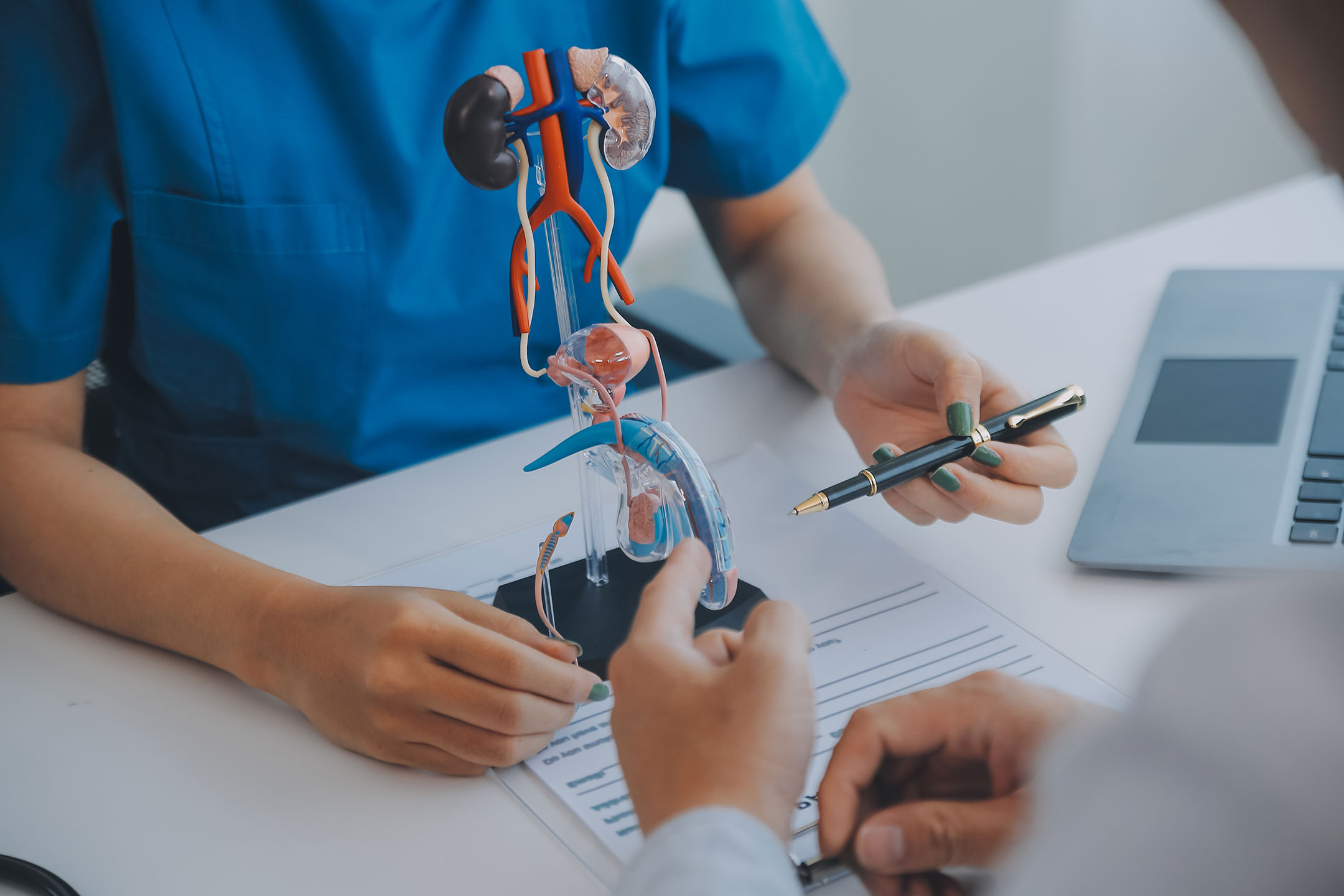
Kidney stones are hard deposits that can form when minerals and salts in the urine crystallise. Some are small enough to pass naturally, while others can cause severe pain, blood in the urine, infection or a blockage in the urinary tract.
Tyneside Urology Partners provides private urology assessment near Newcastle for people with suspected or confirmed kidney stones. If you have symptoms, assessment can help identify the cause and discuss appropriate next steps.
What are kidney stones?
Kidney stones form in the kidneys when substances in urine become concentrated and form crystals. These crystals can join together and grow into stones.
Some stones remain in the kidney and cause no symptoms. Problems often develop when a stone moves into the narrow tube that carries urine from the kidney to the bladder, named the ureter. A stone in the ureter may cause pain, block urine flow or increase the risk of infection.
Kidney stones vary in size, shape and composition. The most common types include:
- Calcium stones – often formed from calcium oxalate or calcium phosphate
- Uric acid stones – which can develop when urine is persistently acidic
- Struvite stones – which may be linked with urinary infection
- Cystine stones – a rare type linked with an inherited condition
The type of stone can help guide prevention advice, particularly if stones recur. If you pass a stone, your clinician may recommend having it analysed.
For more information, visit our page on kidney stones.
Symptoms and warning signs
Kidney stone symptoms can vary. A small stone may cause no symptoms, while a stone that moves or blocks the ureter can cause sudden and severe pain.
Common kidney stone symptoms include:
- Severe pain in the side or back, below the ribs
- Pain that moves towards the lower abdomen or groin
- Pain that comes and goes in waves
- Blood in the urine
- Feeling sick or vomiting
- Needing to pass urine more often
- Urgency to pass urine
- Pain or stinging when passing urine
- Cloudy or unpleasant-smelling urine
- Fever or chills if infection is present
The severe pain caused by a stone in the ureter is often called renal colic. It can be intense and may change location as the stone moves through the urinary tract.
Blood in the urine is known as haematuria. It can be caused by a stone irritating the lining of the urinary tract. This should always be checked by a healthcare professional, even if it happens once.
When is a kidney stone an emergency?
A kidney stone can need urgent treatment if it causes an infection, a significant blockage or uncontrolled symptoms.
Seek urgent medical advice if you have fever or chills with pain in your side or back, or if you cannot pass urine. These symptoms may indicate infection or obstruction and need urgent assessment.
You should also seek urgent advice if you have:
- Severe pain that is not settling
- Vomiting and difficulty keeping fluids down
- Visible blood in the urine
- Symptoms of infection, such as fever, shivering or feeling very unwell
- Difficulty passing urine
- Symptoms during pregnancy
- Symptoms with only one working kidney
- Known kidney disease or reduced kidney function
Use NHS 111 for urgent advice. Attend A&E if symptoms are severe or you feel seriously unwell. Call 999 in an emergency.
What causes kidney stones and who gets them?
Kidney stones can develop when there is not enough fluid in the urine to dilute waste substances. Minerals and salts can then form crystals that gradually grow into stones.
Not drinking enough fluid is a common risk factor, particularly in warm weather, during illness or if you are physically active and lose fluid through sweating.
Other possible kidney stone causes include:
- A previous history of kidney stones
- A family history of stones
- Recurrent urinary tract infections
- Diets high in salt
- High intake of animal protein
- High levels of calcium, oxalate or uric acid in urine
- Some bowel conditions or previous bowel surgery
- Certain medicines or supplements
- Conditions that affect metabolism or hormone balance
Not everyone with kidney stones has an obvious cause. Some people have one stone and never experience another. Others develop recurrent stones and may benefit from more detailed investigations to identify risk factors.
The chance of another stone can be higher after the first. This is why prevention and follow-up is an important part of care.
Passing a stone at home versus needing treatment
Some kidney stones can pass naturally, especially if they are small, located lower in the ureter and not causing infection, significant blockage or uncontrolled pain.
Your clinician will consider several factors before advising whether monitoring may be appropriate, including:
- The size of the stone
- Its location in the kidney or ureter
- The severity of your pain
- Whether you have signs of infection
- Whether urine flow is blocked
- Kidney function
- Your general health and medical history
A clinician may advise pain relief, fluids and monitoring while a small stone passes. You may be asked to filter your urine so that any passed stone can be collected for analysis.
It is important not to try to manage severe pain, fever, vomiting or difficulty passing urine at home without medical advice. A stone may need active treatment if it is unlikely to pass, is causing ongoing symptoms, blocks the kidney or is linked with infection.
How long does it take to pass a kidney stone?
There is no fixed timeframe. Some small stones pass within days, while others can take several weeks. Larger stones or stones located higher in the ureter are less likely to pass without treatment.
The symptoms can also change as the stone moves. Pain may come and go, but persistent or worsening symptoms should be assessed. A scan can help show the stone’s size and position, which are important when discussing whether monitoring remains appropriate.
Treatment options for kidney stones
Kidney stone treatment depends on the stone’s size, location and composition, as well as your symptoms, kidney function and whether infection or blockage is present.
The aim may be to allow the stone to pass, break it into smaller fragments or remove it.
Monitoring and symptom management
Monitoring may be considered for a small stone that is likely to pass and is not causing complications.
Pain relief is likely to be needed while waiting for the stone to pass. Only take medication that is appropriate for you, particularly if you have kidney problems, stomach ulcers or have other long-term health conditions.
Medication to support stone passage
In selected cases, medication may be considered to relax the ureter and make it easier for a stone to pass. This is sometimes called medical expulsive therapy.
It is not suitable for everyone. Your clinician will consider the stone’s size and location, your symptoms and your general health before discussing it.
Shockwave lithotripsy
Shockwave lithotripsy uses sound waves from outside the body to break a stone into smaller pieces. These fragments may then pass in the urine.
It may be considered for certain stones in the kidney or ureter. Whether it is suitable depends on the stone’s size, location and density. More than one session may be needed.
Ureteroscopy
Ureteroscopy involves passing a small telescope through the urethra and bladder into the ureter or kidney. The stone may be removed or broken into smaller fragments using laser energy.
A temporary ureteric stent may sometimes be placed afterwards. This is a small tube that helps urine drain from the kidney while swelling settles. Your clinician will explain why a stent is recommended and what to expect.
Percutaneous nephrolithotomy
Percutaneous nephrolithotomy, often called PCNL, may be considered for larger or more complex stones. It involves making a small opening in the back to access the kidney and remove the stone.
This is a more involved procedure than shockwave treatment or ureteroscopy. It is usually considered when another approach is less likely to be suitable.
Emergency drainage
Urgent drainage may be needed if a stone is causing infection, serious blockage or reduced kidney function. This can involve placing a ureteric stent or a nephrostomy tube to drain urine from the kidney.
The urgent problem is treated first. Further stone treatment can then be planned once it is safe to do so.
Preventing kidney stones from coming back
Kidney stones can recur, but the risk can be reduced with the right prevention plan. This depends on the type of stone, your diet, fluid intake, medical history and the test results.
For many people, drinking enough fluid to keep urine pale is an important first step. The amount you need varies depending on your activity level, weather, work and health conditions.
General measures that can help reduce the risk of further stones include:
- Drinking fluids regularly throughout the day
- Reducing salt intake
- Eating a balanced diet
- Avoiding very high intakes of animal protein
- Maintaining a normal dietary calcium intake (unless advised otherwise)
- Avoiding high-dose supplements
- Seeking treatment for recurrent urinary infections
It is usually not helpful to cut out all calcium without medical advice. For some people, doing so may increase rather than reduce the risk of certain stones.
If you have recurrent kidney stones, a clinician may recommend metabolic assessment. This can include urine and blood tests to look for factors that contribute to stone formation. Stone analysis can also help guide more personalised prevention advice.
Do not make major dietary changes without professional advice if you have kidney disease, diabetes, bowel disease or another long-term health condition.
Rapid private assessment for kidney stone pain in Newcastle
Kidney stone pain can be severe and difficult to manage. Tyneside Urology Partners provides private urology assessment from Team Valley for patients from Newcastle, Gateshead and across the North East.
A consultation can help you understand whether symptoms may be linked to a stone, which investigations may be needed and what treatment options are appropriate.
Book a consultation
To discuss suspected kidney stones, recurrent symptoms or treatment options, make an enquiry with Tyneside Urology Partners.
Frequently Asked Questions
- What are the first symptoms of a kidney stone?
The first symptom is often sudden pain in the side or back. The pain may move towards the lower abdomen or groin and can come in waves. Some people also experience nausea, vomiting, blood in the urine or urinary urgency.
- Can a kidney stone pass on its own?
Yes, some small stones can pass naturally. Whether this is likely depends on the stone’s size and position, as well as your symptoms and whether there is infection or blockage. A clinician can advise after assessment and imaging.
- Are kidney stones serious?
They can be. Some stones pass without causing lasting problems, but others can cause severe pain, infection or blockage of the kidney. Fever with pain, vomiting, severe illness or inability to pass urine needs urgent assessment.
- Can kidney stones cause blood in the urine?
Yes. Stones can irritate the kidney, ureter or bladder and lead to blood in the urine. It may be visible or found only on testing. Blood in the urine should always be checked.
- Will I need surgery for a kidney stone?
Not always. Small stones may pass with monitoring and symptom management. Larger stones, stones causing persistent pain or blockage and stones linked with infection may need treatment such as shockwave lithotripsy, ureteroscopy or PCNL.
- How can I reduce the chance of another kidney stone?
Regular fluid intake, less salt and a balanced diet can help reduce recurrence. If you have repeated stones, stone analysis and metabolic assessment helps to identify more specific prevention measures.
Make an enquiry
If you are concerned about kidney stone symptoms or would like to discuss private kidney stone treatment in Newcastle, book a consultation with Tyneside Urology Partners.