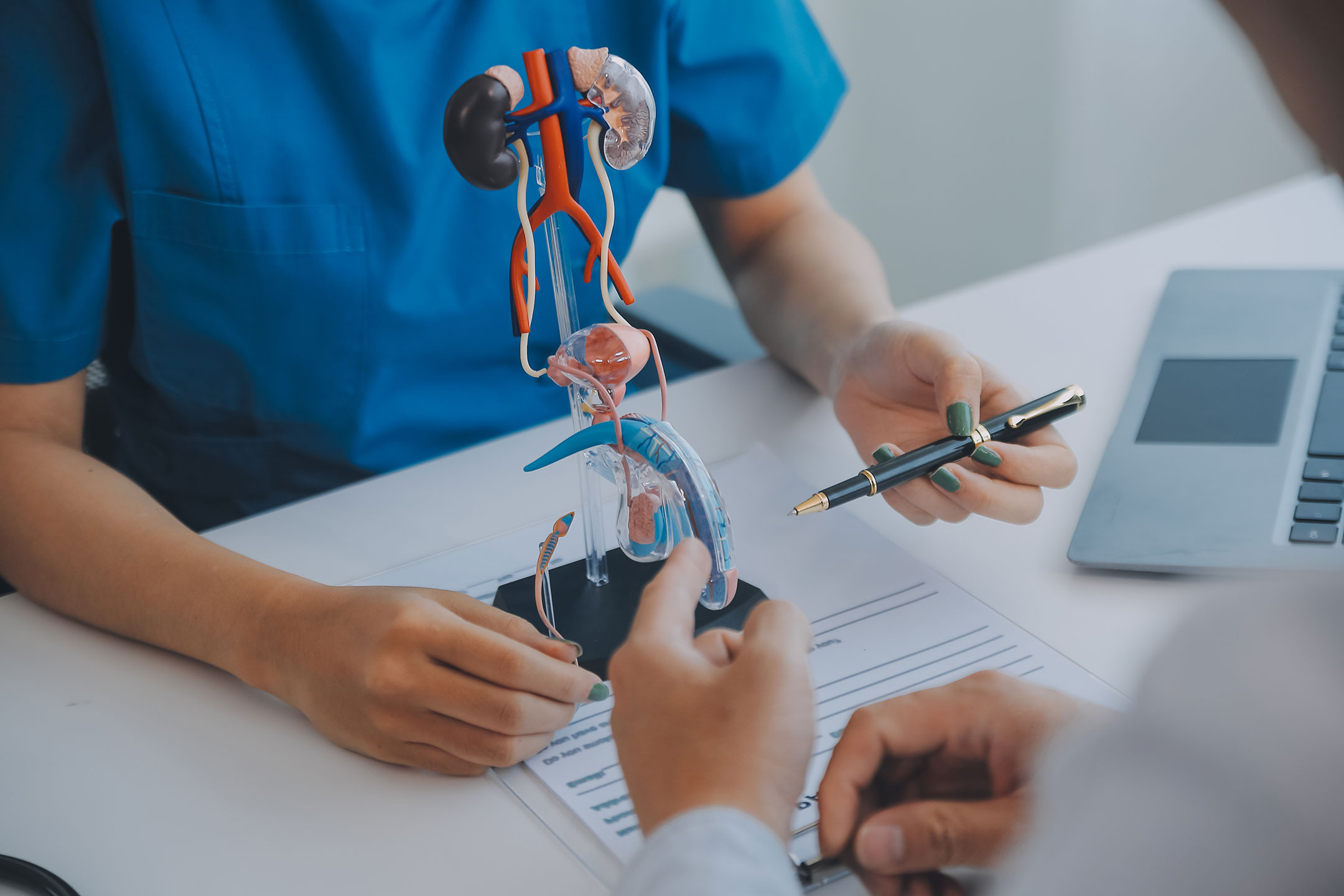
Being concerned about prostate cancer can feel overwhelming, particularly when you are waiting for tests or trying to understand what results may mean. Prostate cancer is common, but it varies widely. Some cancers grow slowly and may not need treatment straight away, while others need closer monitoring or active treatment.
Prostate cancer in context
The prostate is a small gland beneath the bladder that helps produce semen. Prostate cancer develops when cells in the prostate begin to grow abnormally.
Not every prostate cancer behaves in the same way. Some are low risk and may remain within the prostate for many years. Others are more likely to grow or spread beyond the prostate and may need treatment.
Prostate cancer is different from benign prostate enlargement, known as BPH. BPH is a common non-cancerous enlargement of the prostate that can cause urinary symptoms. It does not turn into prostate cancer.
However, both conditions can occur in the same person and can cause similar changes in urination. This means urinary symptoms cannot confirm the cause on their own.
Symptoms and when they appear
At an early stage, prostate cancer symptoms are often not noticeable. This is because the cancer may develop in the outer part of the prostate, away from the urethra (the tube that carries urine from the bladder).
When symptoms do occur, they may include:
- Difficulty starting to pass urine
- A weak or slow urine flow
- Stopping and starting while passing urine
- Needing to pass urine more often
- Urgency to pass urine
- Waking at night to pass urine
- Feeling that the bladder has not emptied fully
- Blood in the urine or semen
- Problems getting or keeping an erection
- Ongoing pain in the back, hips or pelvis
- Unexplained weight loss
These symptoms do not necessarily mean prostate cancer. They can also be caused by an enlarged prostate, prostatitis, urine infection or other conditions. However, changes that are new, persistent or worsening should be assessed.
It is sensible to seek advice if you are concerned about your personal risk. Risk can be higher with increasing age, a family history of prostate cancer, certain inherited gene changes or Black African or Black Caribbean family background.
If you develop severe symptoms, feel very unwell, cannot pass urine or have severe pain, seek urgent medical advice. Contact NHS 111, attend urgent or emergency care or call 999 in an emergency.
How is prostate cancer diagnosed?
Prostate cancer diagnosis usually involves several steps. No single test can provide every answer, so clinicians consider symptoms, medical history, examination findings and investigation results together.
PSA blood test
A PSA test measures the amount of prostate-specific antigen in the blood. PSA is produced by the prostate, but a raised level does not automatically mean cancer.
Raised PSA can happen for several reasons, including benign prostate enlargement, inflammation, infection and prostate cancer. A normal PSA result also cannot rule out every prostate problem. Your clinician can explain the potential benefits and limitations of testing in your circumstances.
Examination and further assessment
A clinician may ask about urinary symptoms, general health, medicines and family history. A digital rectal examination may also be offered. This involves examining the prostate through the rectum to check its size, shape and feel.
An examination can provide useful information, but it cannot diagnose or rule out prostate cancer by itself.
Prostate MRI scan
NICE recommends multiparametric MRI as the first-line investigation for people with suspected clinically localised prostate cancer. An MRI scan provides detailed images of the prostate and can help identify areas that may need further investigation.
A prostate MRI scan can help clinicians decide whether a biopsy is needed and, if so, where samples should be taken from. MRI results are usually reported on a five-point scale, with a higher score suggesting a greater likelihood of clinically significant cancer.
MRI is an important part of the diagnostic pathway, but it does not always provide a definite answer. Further tests may still be recommended.
Transperineal prostate biopsy
A biopsy is the test used to confirm whether cancer cells are present. It involves taking small samples of prostate tissue for laboratory examination.
A transperineal prostate biopsy takes samples through the skin between the scrotum and anus, called the perineum. MRI findings can help guide the biopsy towards areas that need closer assessment.
NICE guidance recognises both transperineal and transrectal approaches as current standards for MRI-influenced biopsy. The transperineal route may reduce the risk of biopsy-related serious infection compared with a biopsy performed through the rectum.
Your clinician should explain why a biopsy may be recommended, how it is performed, potential risks and when you are likely to receive your results.
Understanding your results
If prostate cancer is diagnosed, your clinical team will assess how likely it is to grow or spread. This helps guide discussions about monitoring and treatment.
Two terms you may hear are Gleason score and staging.
Gleason score and Grade Group explained
The Gleason score describes how prostate cancer cells look under a microscope. It is based on the two most common patterns of cancer cells seen in the biopsy sample.
For example, a Gleason score may be written as 3 + 4 = 7. The first number represents the most common cell pattern and the second represents the next most common pattern.
A lower score generally suggests cells that look more like normal prostate cells. A higher score suggests cells that look more abnormal and may be more likely to grow or spread.
You may also be given a Grade Group from 1 to 5. Grade Group 1 is generally the lowest grade and Grade Group 5 is the highest. Grade Groups are now commonly used because they can make the information easier to understand.
A Gleason score or Grade Group is important, but it is only one part of the picture. PSA level, MRI findings, examination results and staging scans are also considered.
Prostate cancer staging
Staging describes where the cancer is and whether it has spread beyond the prostate.
Localised prostate cancer is contained within the prostate.
Locally advanced cancer has grown outside the prostate or into nearby tissues.
Advanced or metastatic prostate cancer has spread to other parts of the body, such as lymph nodes or bones.
Further imaging may be recommended after diagnosis to help establish the stage. Depending on your circumstances, this may include CT, MRI, bone scanning or a specialised PET scan.
Your clinician may also use a risk group to bring together your PSA, Grade Group and stage. This gives a clearer view of the cancer and helps guide the treatment discussion.
Prostate cancer treatment choices
The most appropriate prostate cancer treatment depends on the stage and grade of the cancer, PSA level, your general health and life expectancy, possible side effects and your personal preferences.
Not every prostate cancer needs immediate treatment. For some people, careful monitoring is the preferred initial approach.
Active surveillance
Active surveillance is a planned programme of regular monitoring for suitable people with low-risk or selected intermediate-risk localised prostate cancer. It can include PSA tests, MRI scans, examinations and sometimes repeat biopsy.
The aim is to avoid or delay treatment and its side effects while keeping within a period when curative treatment remains possible if there are signs that the cancer is progressing.
Active surveillance is not the same as doing nothing. It involves scheduled follow-up and review. Active surveillance is recommended for people with the lowest-risk localised cancers, with treatment considered if monitoring suggests progression or if active surveillance is no longer suitable.
Surgery
A radical prostatectomy is an operation to remove the prostate gland and surrounding tissue. It may be discussed for people with localised or locally advanced prostate cancer when treatment with the aim of controlling or curing the cancer is appropriate.
A robotic prostatectomy is one way radical prostatectomy may be performed. It uses robotic-assisted instruments controlled by a surgeon.
Surgery can have important potential benefits, but it also carries risks. These may include urinary incontinence, erectile dysfunction, changes to ejaculation and complications linked with anaesthetic or surgery. Your surgical team will explain the likely benefits, risks, alternatives and recovery considerations in your individual case.
Radiotherapy
Radiotherapy uses radiation to treat cancer cells. It may be used for localised or locally advanced prostate cancer and can be delivered from outside the body, known as external beam radiotherapy. In some cases, internal radiotherapy, called brachytherapy, may be discussed.
Radiotherapy may be combined with hormone treatment for some risk groups. Potential side effects include bladder and bowel changes, tiredness and effects on sexual function. These vary depending on the radiotherapy approach and other treatment used alongside it.
For some people, other treatments may be discussed. These can include hormone therapy, chemotherapy or targeted treatments, particularly when cancer has spread or is at higher risk of progressing.
Is robotic prostatectomy better than other options?
Robotic prostatectomy is not automatically better than active surveillance or radiotherapy. These approaches have different goals, benefits and possible side effects.
For some localised cancers, surgery or radiotherapy may reduce the chance of disease progression compared with active surveillance. They can also carry a greater risk of certain treatment-related effects, including urinary, sexual or bowel changes. The right choice depends on the cancer itself and what matters most to you.
A thorough discussion should cover what each option offers, the uncertainties involved and how treatment could affect your daily life.
Private prostate assessment and second opinions in Newcastle
If you have prostate symptoms, a raised PSA or a recent prostate cancer diagnosis, it can help to speak with a urology specialist who can explain the findings clearly.
Tyneside Urology Partners provides private urology care from Team Valley for patients from Newcastle, Gateshead and across the North East. An assessment or second-opinion consultation can help you understand the investigations, results and treatment options that may be appropriate to discuss.
Book a consultation
To discuss prostate symptoms, test results or treatment options, book a consultation with Tyneside Urology Partners.
Prostate Cancer FAQs
- What are the first signs of prostate cancer?
There are often no symptoms at first. When symptoms occur, they may include urinary changes, blood in urine or semen, erectile difficulties or persistent back, hip or pelvic pain. These symptoms can have other causes, but should be assessed if they are new or ongoing.
- Does a raised PSA mean I have prostate cancer?
No. PSA can be raised by benign prostate enlargement, inflammation, infection and prostate cancer. A raised result may lead to further assessment, but it does not diagnose cancer by itself.
- Does everyone with prostate cancer need treatment straight away?
No. Some slow-growing localised prostate cancers can be managed with active surveillance. This involves regular monitoring and treatment may be recommended later if there are signs of progression.
- What does a Gleason score of 3 + 4 mean?
It means the most common cancer cell pattern seen in the biopsy was graded 3 and the next most common was graded 4. Your clinician will explain what this means alongside your PSA, MRI results, stage and overall risk group.
- Can prostate cancer be diagnosed without a biopsy?
An MRI scan and other tests can provide important information, but a biopsy is usually needed to confirm prostate cancer and assess its grade. In some circumstances, a specialist may discuss whether biopsy can be delayed or avoided.